

DC – Dual Circuit heat exchangers
The HEXONIC DC series is a dual circuit brazed plate heat exchanger designed with two independent refrigerant circuits and one efficient common water circuit. This advanced configuration makes it an ideal solution for refrigeration and heat pump systems that require high performance, compact design, and dependable operation.
Dual Circuit heat exchangers combine two independent refrigerant circuits with a common secondary-side circuit while maintaining full counter-flow. Their design delivers high efficiency under both full and partial load conditions, offering operating flexibility, increased system reliability, and a more compact alternative to traditional parallel heat exchanger arrangements.
Key Features
- High efficiency under full and partial load: The DC design maintains strong thermal performance whether both refrigerant circuits are operating or only one is active.
- Dual circuit operation: Two independent refrigerant circuits improve system flexibility and support more reliable operation in variable-load systems.
- Reduced risk of freezing damage: The DC series is specifically designed to reduce the risk of freezing during operation.
- Compact two-in-one design: By integrating both circuits into a single exchanger, the DC series reduces footprint, piping, and installation complexity.
- Lower installation and service costs: Fewer pipes and simpler installation help reduce both upfront and maintenance-related costs.
- Optimal heat transfer: The exchanger is designed for symmetrical flow and full counter-flow, supporting efficient heat transfer.
- Increased system reliability: In larger refrigeration systems, if one circuit fails, the second can continue to maintain performance.
Design
-
Heating plates
-
Cover plates
-
Refrigeration connections
-
Water connections

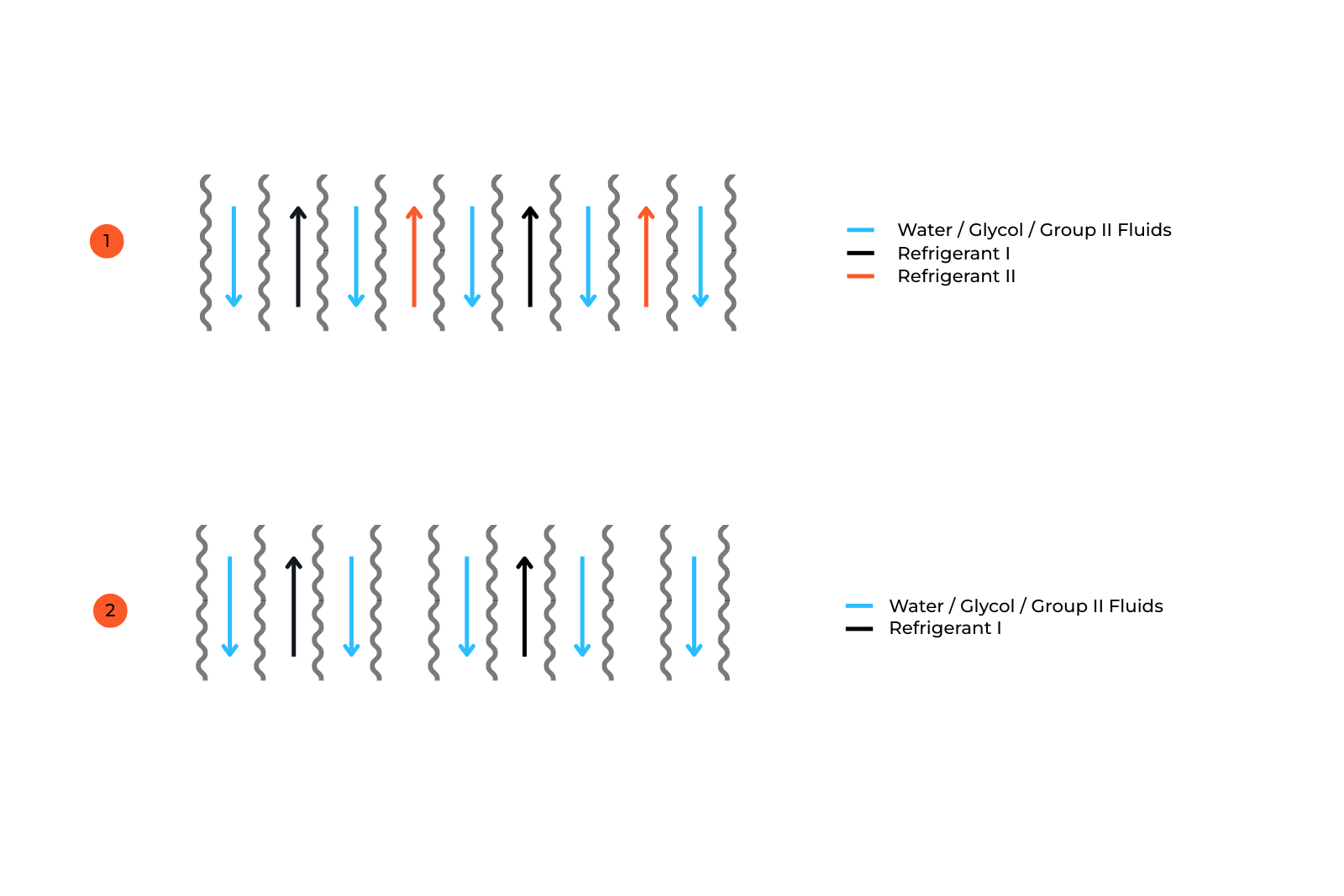
Flow of media in the DC exchanger
1. Flow diagram of the media inside the DC heat exchanger during simultaneous operation of both refrigerant circuits.
2. Flow diagram of the media inside the DC heat exchanger during operation of only one refrigerant
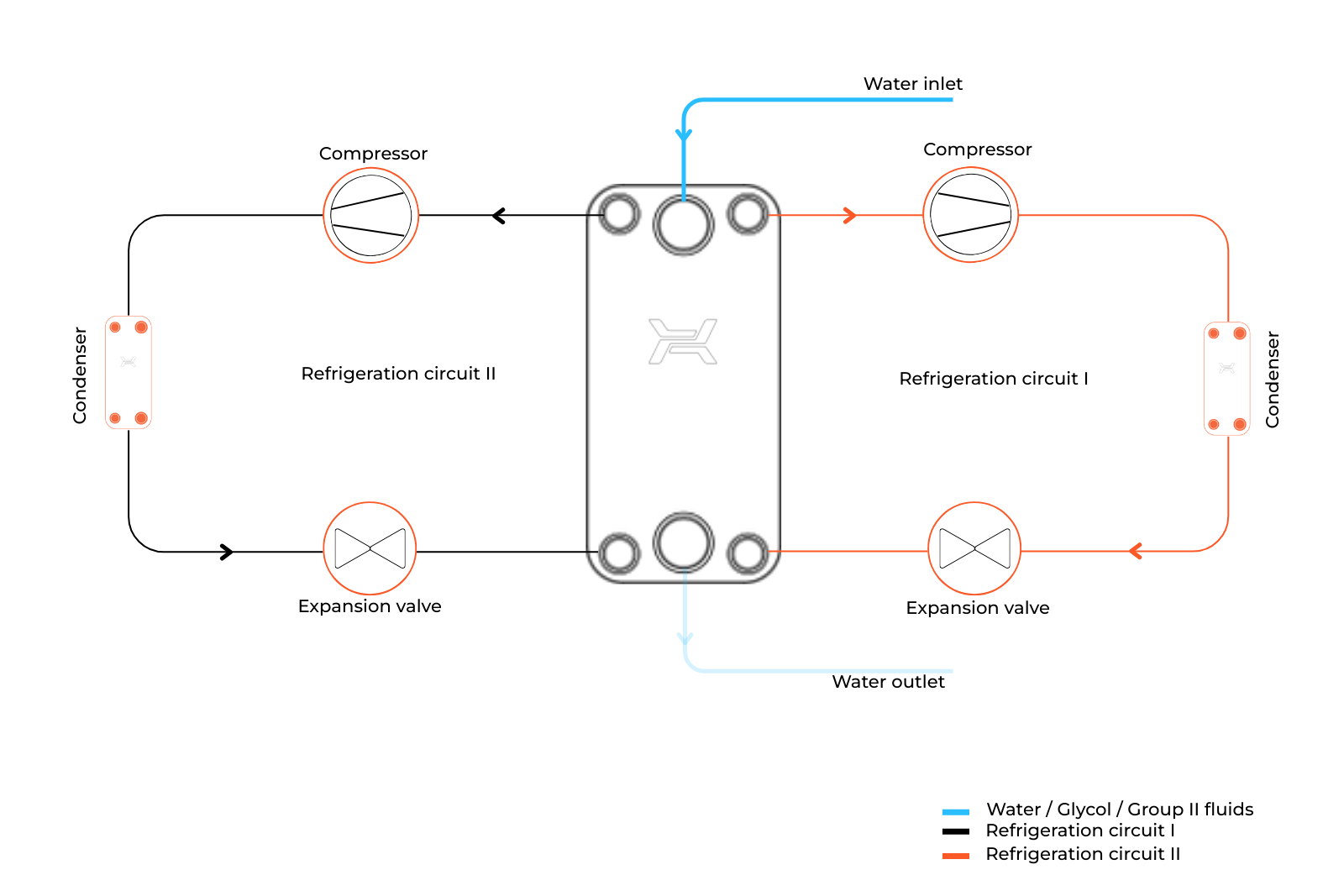
DC system diagram – operation of both circuits
In larger refrigeration systems, two independent refrigerant circuits are often used to better respond to variable loads and increase system reliability. In the event of a failure in one circuit, the other can still maintain performance.
Traditional solutions, such as two parallel heat exchangers, take up more space and increase the risk of freezing during partial operation. Dual Circuit heat exchangers integrate both circuits within a single unit while maintaining full counterflow and even contact with the secondary fluid.
DC FLOW

Technical Specifications
| Design Standards | ASME; PED; UL |
|---|---|
| Max Design Pressure | refrigerant side — 45 bar/653 psi water/glycol side —25 bar/363 psi R LUNA — 25 bar/363 psi |
| Max Design Temperature | 150°C/ 302°F |
| Heating plates Materials | stainless steel, 1.4404 (AISI 316L), copper brazing |
| Front and Rear Plate Materials | stainless steel 1.4301 (AISI 304) |
| Design Types | dual circuit brazed plate heat exchanger |
| Connection Types | external thread / external thread (NPT): from 5/4″ to 5/2″ internal thread / internal thread (NPT): from 1″ to 2″ dual connections (external thread and soldering): from 5/4″ to 5/2″ Victaulic: from 3/2″ to 3″ flange: DN50 PN40 Type 11B / ANSI B16.5 2″ Class 300 SORF soldering connection for R heat exchangers: from 7/8″ to 2 5/8″ |
| Certification | ASME; UL; PED; EAC |
Applications




Frequently Asked Questions
The HEXONIC DC series is designed for systems that use two independent refrigerant circuits together with one common water circuit. It is especially suitable for refrigeration, heat pump, HVAC, and sanitary engineering applications where compactness, flexibility, and reliability are important.
The main advantage is that it combines two refrigerant circuits in one compact exchanger while maintaining full counter-flow and high efficiency under both full and partial load. This reduces space requirements and simplifies installation compared with two parallel exchangers.
In larger refrigeration systems, two independent refrigerant circuits allow the system to respond better to variable loads. If one circuit fails, the other can still maintain performance, increasing overall reliability.
DC series is designed to reduce the risk of freezing damage, which can be a problem in traditional parallel heat exchanger arrangements during partial operation.