

Heat Exchangers for Swimming Pools – Efficient and Cost-Effective Water Heating
Maintaining a comfortable water temperature is one of the key factors in ensuring an enjoyable swimming experience, whether in a private pool, hotel facility or public swimming pool. Pool water has a high heat capacity, which means that heating it requires equipment capable of transferring heat from the heating system to the pool circuit quickly, safely and efficiently. This is exactly the role of heat exchangers, one of the most widely used solutions in swimming pool installations.
How does a pool heat exchanger work?
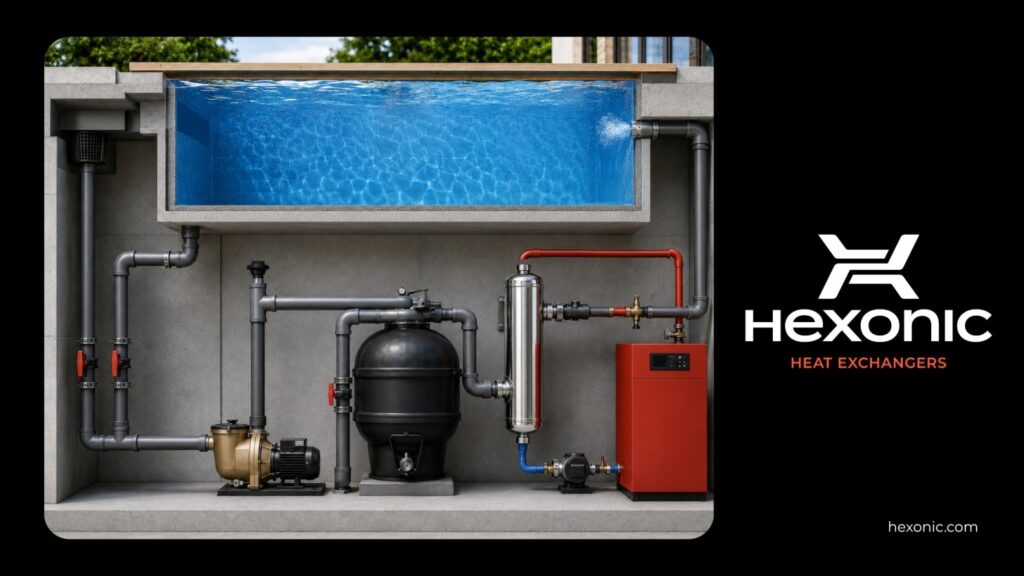
A heat exchanger transfers thermal energy between two separate circuits: the heat source circuit and the pool water circuit. On one side of the unit, a heating medium flows through the exchanger — for example, water from a boiler, heat pump or central heating system. On the other side, pool water flows through the unit and absorbs heat, without ever mixing with the heating medium.
This separation is important because pool water contains treatment agents such as chlorine, salt or other chemicals. Keeping the two circuits apart improves safety, protects the equipment and helps ensure stable operation of the entire system.
Why is a heat exchanger a good solution for a pool?
A pool heat exchanger makes it possible to heat the water quickly to the desired temperature and then maintain it at a consistent level. This is especially important for outdoor pools, where heat loss depends on air temperature, wind and water evaporation. In indoor pools, a heat exchanger helps provide year-round comfort for users.
Hexonic points out that pool heat exchangers are used for fast and economical water heating, and that shell-and-tube heat exchangers are often used in domestic pool installations.
Hexonic heat exchangers in pool installations
Hexonic offers several solutions designed for swimming pool applications, including the REV, B, TI and REV TI heat exchangers. Each type is suited to different installation requirements — from standard residential pools to more demanding facilities with salt water.
The REV series was designed primarily for pool installations. These heat exchangers achieve a high heat transfer coefficient thanks to a three-pass design on the tube side, allowing the system to make better use of the available heat output.
Type B heat exchangers are known for their high thermal performance and are intended, among other applications, for high-flow installations, including pools of various types and sizes.
In saltwater pools, corrosion resistance is particularly important. Hexonic offers TI titanium heat exchangers, which are designed for pool installations supplied with salt water. According to the manufacturer, titanium provides resistance to aggressive substances such as salt, chlorine and fluorine.
Choosing the right heat exchanger for the type of water
Selecting the right heat exchanger depends not only on the size of the pool, but also on water quality, the treatment method and the heat source. Hexonic notes that in pools with treated water, the heat transfer surface may be made of stainless steel or titanium tubes, or plates in the case of plate heat exchangers.
For chlorinated pools, stainless steel units are often sufficient, provided that the correct water chemistry parameters are maintained. In saltwater systems or more aggressive environments, titanium heat exchangers such as Hexonic TI or REV TI are recommended.
The importance of efficiency and low pressure drops
A good pool heat exchanger should not only transfer heat effectively, but also avoid creating excessive flow resistance. High pressure drops place a greater load on pumps, which in turn increases electricity consumption.
In its catalogue materials, Hexonic states that the special design of its pool heat exchangers increases heat transfer intensity, while straight tubes help reduce pressure drops in the installation. The corrugated tube surface promotes turbulent flow, which improves heat transfer and helps reduce the build-up of deposits.
Compatibility with different heat sources
Heat exchangers can work with a wide range of energy sources, including gas boilers, heat pumps, solar systems, district heating networks and central heating installations. This makes them a flexible solution suitable for both new projects and modernised pool systems.
Hexonic describes its pool heat exchangers as compatible with various types of heating and pool installations, highlighting their high efficiency, easy installation and reliability.
Summary
A heat exchanger is one of the key components of a swimming pool installation. It is responsible for transferring heat efficiently from the heat source to the pool water, without mixing the two circuits. A properly selected heat exchanger can shorten water heating time, reduce operating costs and help maintain a stable pool temperature.
Hexonic ’s range includes heat exchangers designed for different types of pool installations — from standard stainless steel solutions to titanium models for saltwater applications. This makes it possible to select a unit that matches the type of pool, the water treatment method and the required performance level.