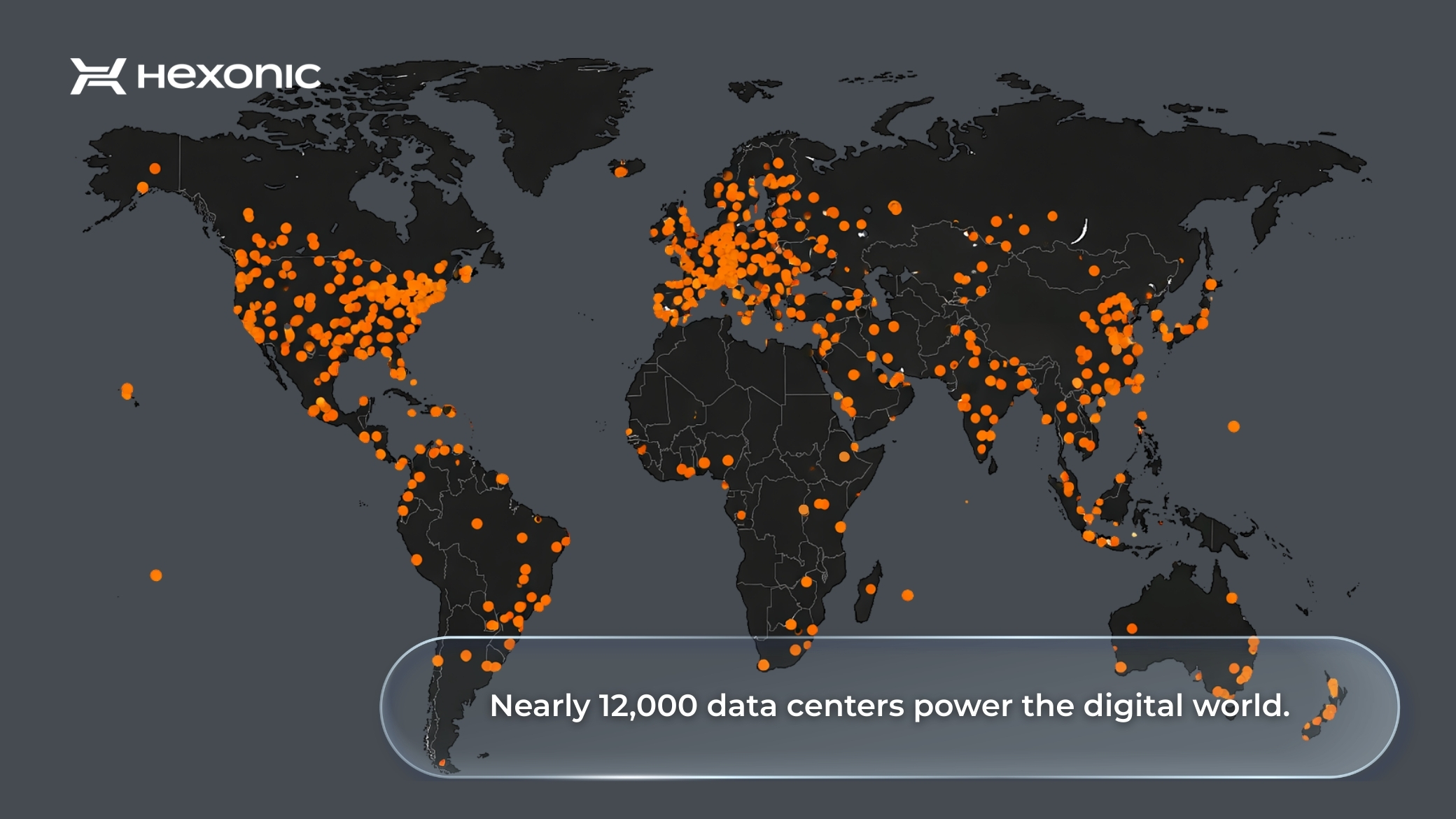
The digital economy is expanding at a pace that would have been difficult to imagine just a few years ago. Artificial intelligence, cloud computing, streaming services, and the Internet of Things all rely on a single underlying infrastructure: data centers.
However, as demand for computing power continues to grow, so does one of the most significant technical challenges facing this infrastructure: heat.
An analysis of the global data center landscape reveals a paradox of modern digital infrastructure. Most data centers are not built in locations that are climatically optimal for their operation. Thousands of facilities operate in regions where temperatures significantly exceed the range considered most efficient for IT systems.
This is not accidental—it is a consequence of economic realities.
Data centers are built where electric power, network connectivity, and digital service users are available. As a result, IT infrastructure increasingly operates in hot, humid, or otherwise extreme climates.
This leads to one clear conclusion: thermal management is becoming a core capability in designing digital infrastructure.
The Era of High Power Density
A decade ago, many server rooms were designed for power densities of just a few kilowatts per rack. Today, in AI and high-performance computing environments, densities of 40–100 kW per rack are becoming common—and in some installations even higher.
This changes everything.
Traditional air-based cooling systems are approaching their physical limits. As power density increases, demand grows for more advanced thermal management solutions—from liquid cooling systems to integrated heat recovery technologies.
In practice, this means a shift in perspective: cooling is no longer treated as a supporting system but rather as a core energy infrastructure of the data center.
Heat as Part of the Energy Architecture
For years, heat generated by servers was seen purely as a problem that needed to be removed.
Today, it is increasingly viewed as a valuable energy resource.
In many European cities, waste heat from data centers is already being fed into district heating systems, helping to warm residential and office buildings. In other cases, it is used in industrial processes or smart-city energy systems.
This trend reflects a broader transformation in the energy model of digital infrastructure.
Data centers are no longer only consumers of energy—they are becoming part of an integrated energy ecosystem.
Why Heat Exchange Technology Is Becoming Critical
At the center of this transformation lies a component that for years remained largely unnoticed: heat exchange technology.
Heat exchangers enable efficient energy transfer between different thermal circuits within the system, including:
- server cooling loops
- chilled water systems
- free-cooling installations
- heat recovery systems
- district heating networks
As power density increases and energy efficiency requirements such as PUE (Power Usage Effectiveness) become more demanding, the importance of high-efficiency, reliable, and scalable heat exchange solutions continues to grow.
For infrastructure designers, this means cooling systems must be designed not only for performance, but also for integration with future energy systems.
Designing Data Centers in a Warming World
Climate change is further accelerating this trend. In many regions, average temperatures are rising, and extreme heat waves are becoming more frequent.
For data center operators, this translates into increasing operational risks and a growing need for more resilient and flexible cooling systems.
Designing data center infrastructure in the coming years will require a new approach focused on:
- energy efficiency
- climate resilience
- energy recovery capabilities
- scalable cooling systems
Digital Infrastructure Needs a New Thermal Engineering
As the digital economy continues to grow, data centers are becoming one of the most critical infrastructures of the modern world.
At the same time, their future will increasingly depend on how effectively we manage thermal energy.
In the coming decade, technologies related to heat exchange, liquid cooling, and energy recovery will become some of the most important areas of innovation in the data center industry.
This is no longer just about cooling servers.
It is about designing a new energy architecture for digital infrastructure.