Cleaning Hexonic GPHE – a Fast Way to Restore Heat Transfer Performance
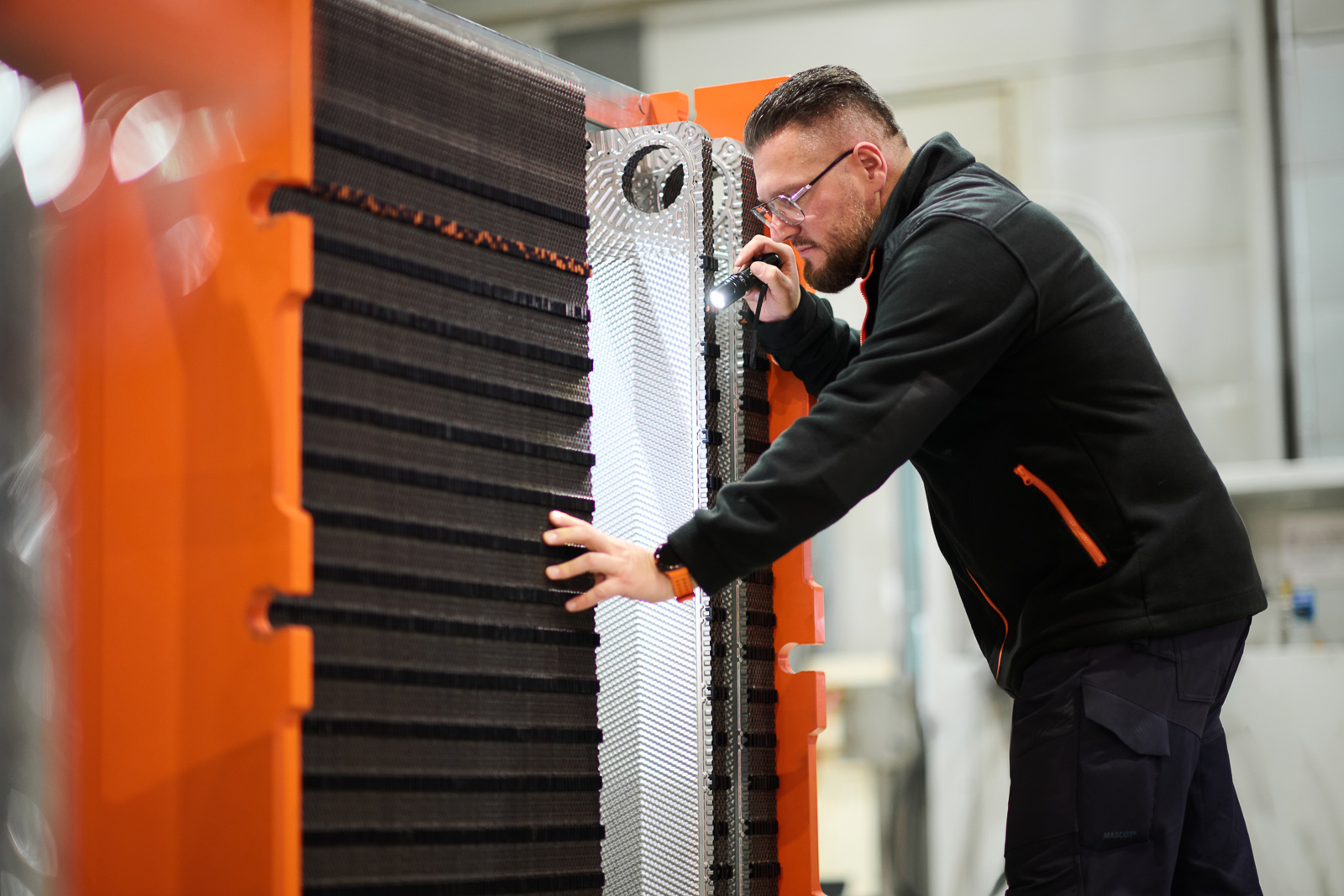
Gasketed Plate Heat Exchangers (GPHE) are among the most efficient heat transfer solutions used in industry today. Thanks to their compact design and large effective heat transfer surface, they deliver exceptional thermal performance in a relatively small footprint. However, this same design also makes them particularly sensitive to fouling. Narrow flow channels are prone to scale, process deposits, and corrosion by-products.
Maintenance teams know the symptoms all too well:
- increased pressure drop (ΔP)
- reduced heat transfer efficiency – often by as much as 30%
- higher energy consumption
- unstable process conditions
- growing risk of unplanned downtime
Fortunately, modern Clean-in-Place (CIP) methods make it possible to restore performance quickly—without dismantling the plate pack.
How does chemical CIP cleaning of GPHE work?
CIP cleaning is based on circulating a properly selected chemical solution (typically a descaling agent diluted with water) through the heat exchanger. For GPHE units, the way the process is carried out is critical.
Bottom-to-top flow
The cleaning solution is introduced at the lower connection and returned from the top of the exchanger. Why does this matter?
As scale dissolves, foam and CO₂ are generated. These naturally rise upward. This flow arrangement:
- prevents air locking inside the exchanger,
- allows continuous removal of gases,
- ensures stable and uniform circulation of the active solution.
The result: no “air pockets” and far more effective cleaning across the entire plate surface.
Flow reversal – the key to blocked channels
One of the most important elements of professional CIP is periodic flow reversal.
This delivers two major benefits:
- helps evacuate accumulated foam,
- assists in reopening partially blocked channels.
During cleaning, so-called dead zones can form—areas where the chemical has already been neutralized and no longer reacts with deposits. Reversing the flow briefly pulls the solution back and replaces it with fresh, active chemistry, which attacks the scale again.
This mechanism is what enables effective removal of even heavily compacted deposits.
What happens to the fouling?
During CIP:
- scale and contaminants are chemically dissolved,
- converted into a liquid suspension,
- continuously flushed out of the plate channels.
The outcome:
- restored full flow cross-section,
- significantly reduced ΔP,
- recovery of original heat transfer performance.
For GPHE units, this means a real return to design efficiency—without opening the exchanger and without extended shutdowns.
When is it time to clean?
Typical warning signs include:
- noticeable increase in pressure drop,
- deteriorating temperature performance,
- heat transfer efficiency loss of around 30%.
At this point, CIP is no longer optional—it becomes essential.
Fast process, minimal impact on production
One of the biggest advantages of closed-loop chemical cleaning is speed:
- the cleaning itself usually takes 2 to 6 hours, depending on fouling severity,
- the entire process—from isolating the exchanger to restarting operation—can typically be completed in under 8 hours.
With proper installation (isolation valves and connection points close to the exchanger):
- there’s no need to dismantle permanent pipework,
- hoses are connected,
- circulation and flushing are performed,
- the system is closed and returned to service.
This is a major advantage over traditional dismantling and manual cleaning.
Why CIP should be standard practice for GPHE maintenance
Regular plate heat exchanger cleaning:
- stabilizes process parameters,
- reduces energy costs,
- lowers the risk of failures,
- extends plate and gasket lifetime,
- minimizes production downtime.
In practice, it’s one of the most cost-effective preventive maintenance measures for systems relying on plate heat exchangers.
GPHE from Hexonic – performance worth maintaining
Hexonic JAG plate and frame heat exchangers are engineered for high efficiency and flexible configuration. But to preserve these advantages over time, regular professional CIP cleaning is essential.
Today, CIP is no longer an “extra”—it’s a core part of modern maintenance strategies.
Summary
If GPHE heat exchangers are operating in your plant, it’s worth treating cleaning not as a reaction to problems, but as a proactive way of managing process performance.
Chemical CIP cleaning:
- removes scale from the narrowest channels,
- restores heat transfer efficiency,
- minimizes downtime,
- delivers real operational cost savings.
In a world where every hour of downtime matters—this is simply a solution that pays off.
Have questions or need support? Contact the service team at Hexonic — their experts will help you select the right cleaning approach for your GPHE units. –> https://hexonic.com/en/heat-exchanger-service/