How Hexonic engineered a customized chocolate cooling system operating close to the product’s crystallization temperature
Cooling liquid chocolate is one of the most demanding heat transfer processes in the food industry. The product must be cooled to a temperature very close to its crystallization range without causing premature crystal formation, excessive pressure loss or interruptions to production.
In a project carried out with Raptronic Process Engineering, Hexonic was asked to develop a system capable of cooling 18 tonnes of liquid chocolate per hour from 68°C to approximately 45°C. The required heat duty was 231 kW, with water used as the cooling medium. The final solution consisted of two DNA 508 shell and tube heat exchangers connected in series.
Why is liquid chocolate difficult to cool?
Chocolate is a non-Newtonian fluid. Its apparent viscosity is not constant but varies depending on:
- temperature,
- shear rate,
- product composition,
- flow conditions.
As chocolate cools, its viscosity increases considerably. This affects pressure loss, flow distribution and heat transfer performance, making thermal and hydraulic calculations significantly more complex than those for water, glycol or standard industrial fluids.
Another major concern is the possibility of localized crystallization at the heat transfer surface. Even when the average bulk temperature remains within the safe operating range, the temperature directly at the tube wall may be substantially lower.
For this reason, the heat exchanger could not be selected using catalogue parameters alone.
Can a shell and tube heat exchanger cool liquid chocolate?
Yes. A shell and tube heat exchanger can cool liquid chocolate when its geometry, flow conditions and temperature profile are properly engineered.
Chocolate cooling systems commonly use more expensive scraped surface heat exchangers. Conventional tubular exchangers are often considered unsuitable because of the product’s high viscosity and crystallization risk.
Instead of rejecting the technology, Hexonic carried out several iterations of thermal, hydraulic and rheological calculations. The analyses showed that a customized shell and tube unit could provide stable cooling without causing crystallization within the bulk chocolate stream.
Key project parameters
| Parameter | Value |
|---|---|
| Product | Liquid chocolate |
| Capacity | 18 t/h |
| Inlet temperature | 68°C |
| Outlet temperature | 45°C |
| Heat duty | 231 kW |
| Cooling medium | Water |
| Equipment | 2 × DNA 508 |
| Configuration | Series |
| Product side | Shell side |
| Installation | Horizontal |
| Shell diameter | 508 mm |
| Material | Stainless steel |
The project specification also included a logarithmic mean temperature difference of 10.6°C and custom shell nozzles extended by 60 mm.
Chocolate flowing on the shell side
One of the most important engineering decisions was to direct the chocolate through the shell side of the heat exchanger.
The shell side provides a larger free-flow cross-section than conventional tubes. For a highly viscous product, this helps to:
- reduce pressure drop,
- improve product flow,
- limit localized stagnation,
- create a more uniform velocity distribution,
- facilitate drainage.
The larger flow area was especially important at a production capacity of 18 t/h. It reduced the probability of chocolate remaining in low-velocity zones, where it could cool excessively or begin to crystallize.
Two heat exchangers connected in series
The cooling duty was divided between two DNA heat exchangers connected in series.
The first exchanger removed most of the thermal energy from the chocolate. The second unit provided precise final cooling to the required outlet temperature.
This arrangement avoided an excessive temperature reduction in a single stage. Gradual cooling:
- limits maximum temperature gradients,
- reduces the risk of local overcooling,
- improves final temperature control,
- stabilizes the entire process.
The calculated temperature profiles confirmed that cooling remained smooth and controlled throughout both stages.
Modelling chocolate viscosity and flow behaviour
One of the most difficult aspects of the project was the limited availability of reliable product property data.
Chocolate viscosity and density change with temperature. Chocolate also demonstrates shear-thinning behaviour, meaning that its apparent viscosity decreases as the shear rate increases.
These rheological characteristics had to be included when determining:
- pressure losses,
- flow velocity,
- local heat transfer coefficients,
- tube wall temperature,
- required heat transfer area.
As additional process information became available, the thermal and hydraulic models were progressively updated. This allowed the final exchanger geometry to reflect actual operating conditions rather than relying only on simplified assumptions.
Controlling the temperature at the tube wall
A critical stage of the engineering process involved analysing three different temperatures:
- the bulk chocolate temperature,
- the temperature at the heat transfer surface,
- the metal tube wall temperature.
The simulations showed that the surface temperature could locally approach the chocolate crystallization range. However, the temperature of the bulk product remained safely above the critical level.
This meant that conditions favourable to crystallization could occur only locally at the tube wall and would not lead to crystal formation throughout the main chocolate stream. Efficient cooling could therefore be achieved while maintaining stable operation and product quality.
Customized DNA heat exchanger design
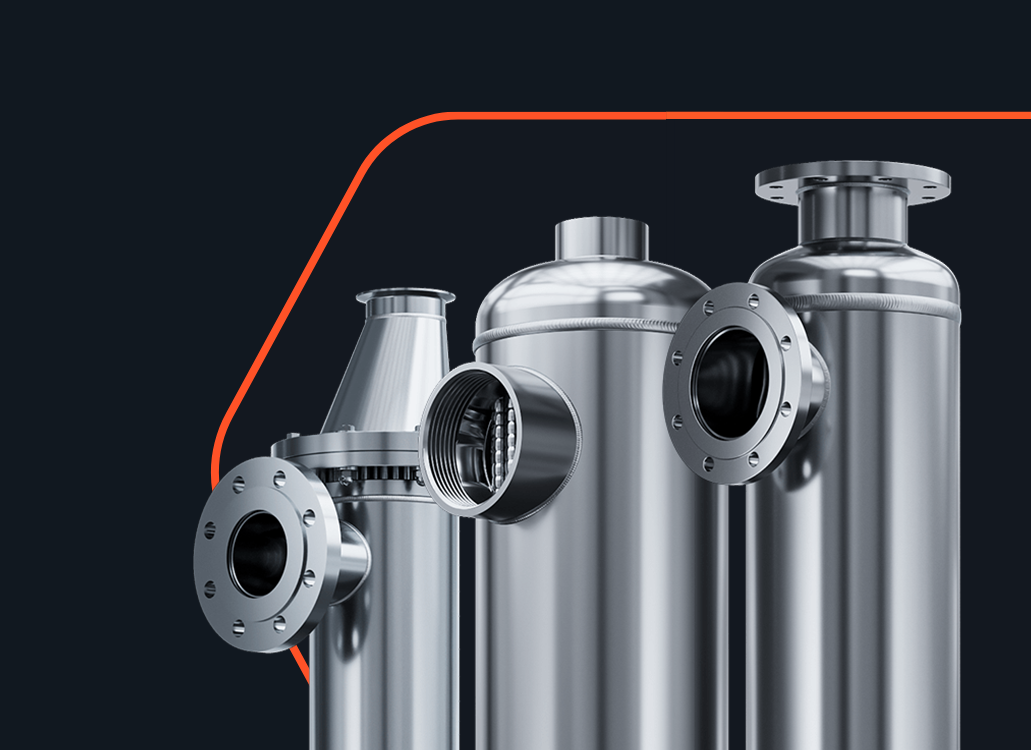
The project used two customized DNA 508.10.S610 FS.PRO.SS shell and tube heat exchangers.
The main design adaptations included:
- horizontal installation,
- shell-side chocolate flow,
- a non-standard nozzle arrangement,
- shell-side flange neck extensions of 60 mm,
- an insulation-ready design,
- elimination of potential dead zones,
- full CIP cleaning without dismantling.
Horizontal installation facilitated drainage of the viscous product from the shell side. The extended flange necks created sufficient space for thermal insulation without affecting the original piping and installation concept.
Project results
The completed installation demonstrated that customized shell and tube heat exchangers can operate successfully in applications traditionally associated with more complex and expensive technologies.
The customer achieved:
- stable cooling of 18 t/h of liquid chocolate,
- a temperature reduction from 68°C to approximately 45°C,
- operation close to the crystallization limit,
- a smooth and controlled cooling profile,
- reduced operational complexity,
- lower investment costs compared with conventional alternatives,
- equipment fully adapted to the production process,
- CIP cleaning capability.
The project confirmed that a shell and tube heat exchanger can be a viable alternative for selected chocolate cooling duties, particularly when it is designed using reliable rheological data and a detailed analysis of the wall temperature.
Why does this project matter?
This case demonstrates that demanding process applications do not always require the most common or most expensive technology.
For viscous and non-Newtonian products, successful heat exchanger design depends on:
- understanding the physics of the process,
- obtaining reliable rheological data,
- conducting accurate thermal and hydraulic calculations,
- controlling the heat transfer surface temperature,
- customizing the equipment beyond standard catalogue designs.
The value of a solution is determined not only by the selected heat exchanger type, but also by the engineering expertise used to adapt it to the actual product and production process.
FAQ – chocolate cooling heat exchangers
What type of heat exchanger can be used for cooling liquid chocolate?
A properly engineered shell and tube heat exchanger can be used for liquid chocolate. Its design must account for high viscosity, non-Newtonian behaviour, acceptable pressure drop and the risk of crystallization at cold surfaces.
Why was the chocolate directed through the shell side?
The shell side provides a larger free-flow area, reducing pressure losses and the risk of product stagnation. This is particularly beneficial for highly viscous chocolate.
Why were two heat exchangers connected in series?
Two cooling stages provide a gradual temperature reduction. The first exchanger removes most of the heat, while the second controls the final outlet temperature. This reduces the risk of local overcooling and crystallization.
Can chocolate crystallize at the tube surface?
The surface temperature may locally approach the crystallization range. Correct thermal modelling ensures that the bulk chocolate temperature remains above the critical limit.
Can the heat exchangers be cleaned without dismantling?
Yes. The exchangers were designed for full Cleaning in Place, or CIP, without dismantling the equipment.
What information is required to size a chocolate heat exchanger?
The required data normally include:
- chocolate flow rate,
- inlet and outlet temperatures,
- rheological properties,
- viscosity at different temperatures and shear rates,
- allowable pressure drop,
- cooling medium parameters,
- CIP and hygienic requirements.